

The global economy is currently navigating a convergence of high-velocity shocks that defy conventional wisdom. As we move into the winter of 2026, the traditional map of geopolitical influence is being redrawn by a severe European energy crisis, desperate technological defiance in Asia, and a strategic pivot toward the Arctic.
For the astute investor, moves in the Strait of Hormuz or security deals in Greenland are not merely distant headlines; they are the primary drivers of an “energy risk premium” now being baked into global equities. Understanding the difference between the “emotional noise” found on social media and the “disciplined signals” of global capital is no longer a luxury—it is a requirement for survival. In this volatile macro environment, the following five shifts represent the new pillars of the global landscape.
1. The 60% Shock: Europe’s Structural Deindustrialization
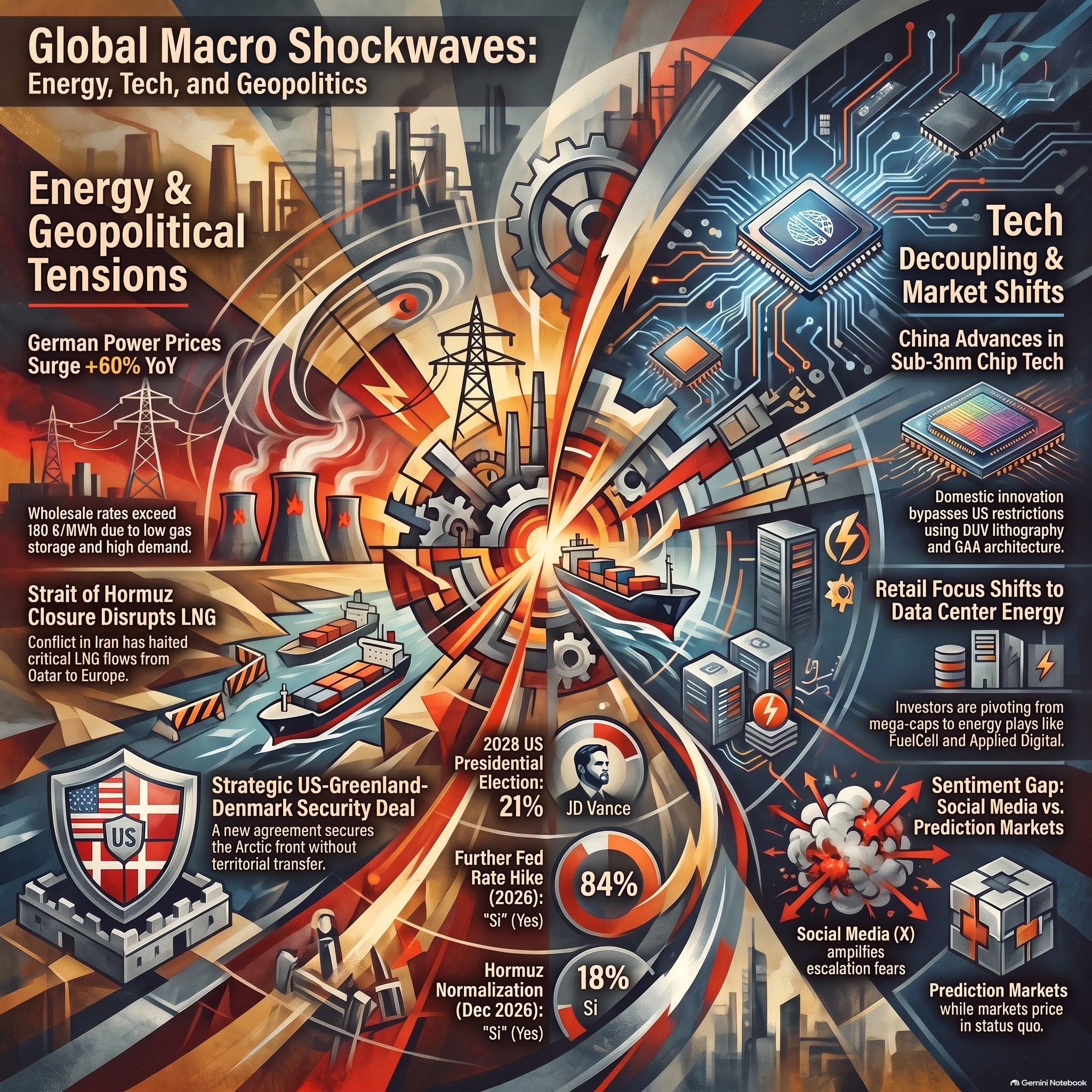
Europe enters this winter with electricity markets at their highest alarm level since the 2022 crisis. According to the latest “MACRO GRISA” reports, German wholesale power prices for January have surged past 180 €/MWh—a staggering 60% year-over-year increase.
This isn’t just a seasonal spike; it is an asymmetric risk manifesting through a “perfect storm” of supply constraints. Natural gas storage levels sit at 15-year lows, and the geopolitical closure of the Strait of Hormuz has effectively severed the Liquefied Natural Gas (LNG) lifeline from Qatar. The implications extend far beyond household utility bills; we are witnessing the risk of “structural deindustrialization” as energy costs remain prohibitive for the continent’s manufacturing core.
Bullish pressure on TTF and power prices is forcing a move into selective utilities while placing a heavy energy risk premium on European equities.
2. Tech Defiance: China’s 18.9% Catalyst
The recent announcement from the Chinese Academy of Sciences regarding a sub-3nm chip breakthrough is being viewed by many as a miracle of domestic resilience. By utilizing Deep Ultraviolet (DUV) lithography and Gate-All-Around (GAA) stacked nanosheet architecture, Beijing is attempting to bypass the US-led blockade on Extreme Ultraviolet (EUV) tools.
However, to understand why this breakthrough is occurring now, one must look at the structural decay of the Chinese growth engine. China’s credit-driven model is exhausting its space, and in August, urban youth unemployment hit a methodology-record 18.9%. This isn’t just a tech race; it’s an economic necessity. With the old models of expansion failing, the CCP is forced to pivot toward high-end manufacturing to absorb a restless, over-educated workforce. This tech defiance is a signal that the restriction environment has not stalled China, but rather accelerated its desperate transition toward a new domestic architecture.
3. The “AI Utility” Trade: Energy as the Primary Constraint
We are seeing a profound rotation in market leadership. As the narrative around “Big Tech” matures, retail and institutional capital are flowing into the physical infrastructure that makes AI possible. Energy infrastructure is now the primary constraint on AI scaling.
Data from BCA Research highlights the sheer scale of this demand: in Finland alone, data center requirements are projected to spike from 360 MW to 1.2 GW by 2030. This has turned the spotlight on nuclear and hydro utilities, with companies like Bloom Energy (BE), FuelCell Energy (FCEL), and Applied Digital (APLD) becoming the new favorites of the StockTwits crowd. Investors are realizing that without localized, reliable power, the AI revolution is a non-starter.
“A large data center operator needs generation in Texas within a set, relatively near-term timeframe... FuelCell is following industry practice.” — StockTwits Pulse.
4. The Prediction Gap: Capital Flows vs. Social Media Apocalypse
There is a widening chasm between the “apocalyptic” sentiment on platforms like X and the cold, disciplined signals of prediction markets. While social media amplifies scenarios of total regional collapse in the Middle East following the elimination of Khamenei, capital-backed markets like Polymarket remain more conservative, pricing in a “war of attrition” rather than a total system failure.
Monetary Policy: Prediction markets currently price in an 84% probability of a further Fed rate hike before year-end, following the 25bps hike in September.
Geopolitics: While X users predict a direct US-Iran ground war, the market assigns only a 14-28% probability to a terrestrial invasion. Similarly, Nicolás Maduro’s grip on Venezuela is priced at a high 82-84% probability of survival through 2026.
Succession: In the 2028 US Presidential race, JD Vance maintains a 21% leadership in prediction markets—a signal of perceived stability in the Republican line of succession that social media debates often overlook.
This “gap” suggests that while the headlines are loud, global capital is betting on the continuation of a “low-boil” status quo rather than sudden, cataclysmic breaks.
5. The Arctic Pivot: The Greenland Security Deal and CRML
The strategic necessity of the North is no longer a theoretical concern for NATO. A new trilateral security agreement between the USA, Denmark, and Greenland has stabilized the Arctic front. While the deal avoids the cession of territory, it significantly expands Washington’s security umbrella over the region’s vast resources.
This move is a direct response to the energy fragility seen in Europe. The agreement brings the “Tanbreez” rare earth project into sharp focus, highlighting Critical Metals Corp (CRML) as a primary vehicle for Western resource independence. As the West seeks to decouple from Eastern supply chains, the Arctic is becoming the new frontier for the minerals essential to the green energy transition and defense manufacturing.
Conclusion: A New Map for 2026
The global landscape is being reshaped by energy security, technological resilience, and the disciplined signals of the market. From the 60% power price shock in Germany to China’s sub-3nm gamble, the message is clear: physical constraints and structural economic pressures are overriding the easy-money narratives of the last decade.
As a macro strategist, the question I pose is simple: Are you following the “emotional noise” of your social media feed, or are you tracking the “disciplined signal” of capital flows? In a world of 18.9% youth unemployment and 15-year gas storage lows, clarity—rather than hype—is the only asset that yields a true return. Following the money, rather than the headlines, remains the only way to navigate the cold front ahead.